Express weaving

I once came across this interesting video – a clever weaving technique on the inkle loom that allows for dizzying speed in the formation of the selvedge.

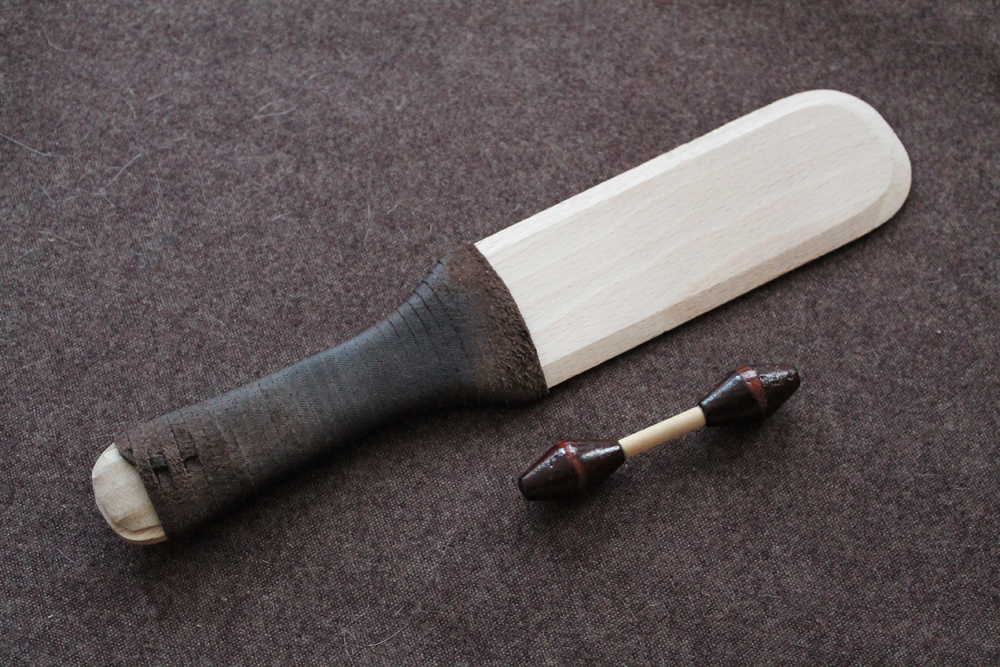
I decided to try it in my workshop. The small bidel was made from a wooden pancake spatula. In the improved version, the handle is wrapped in a strap, because the edges - although not sharp - were digging into my hands. I initially made the shuttle from 2 buttons and a piece of drinking straw. The second version is 2 wooden beads and a stick.
My warp is tilted – not horizontal, so I changed the position of my hands a little. I hold my left hand with the shuttle above the selvedge – both hands are more or less at the same level, which makes work more comfortable. Seweryn took photos of me weaving.
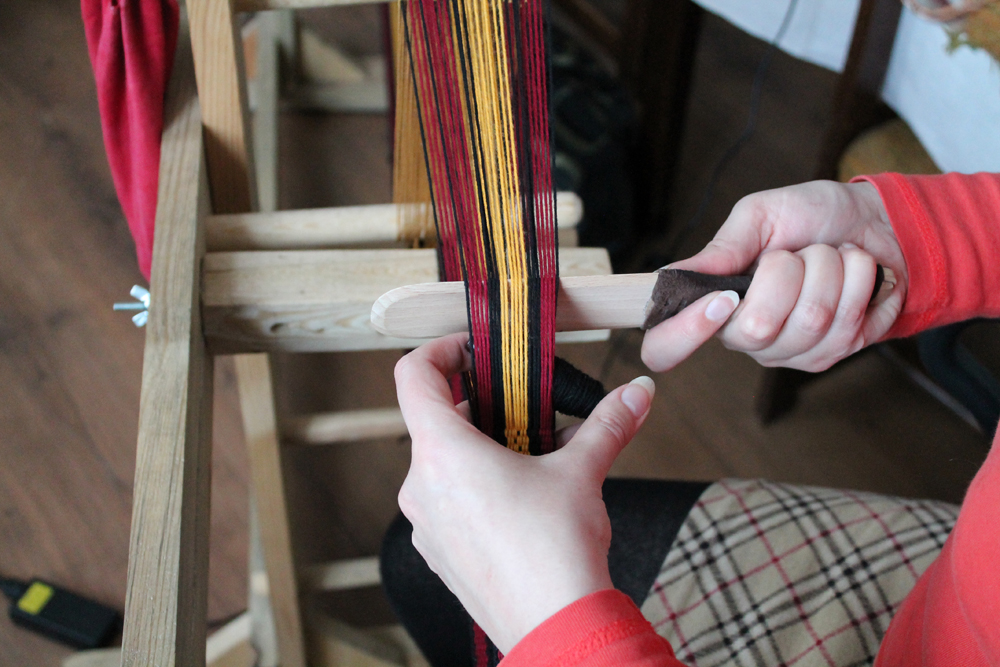
I pull the selvedge up and pass the shuttle through the isthmus from right to left.
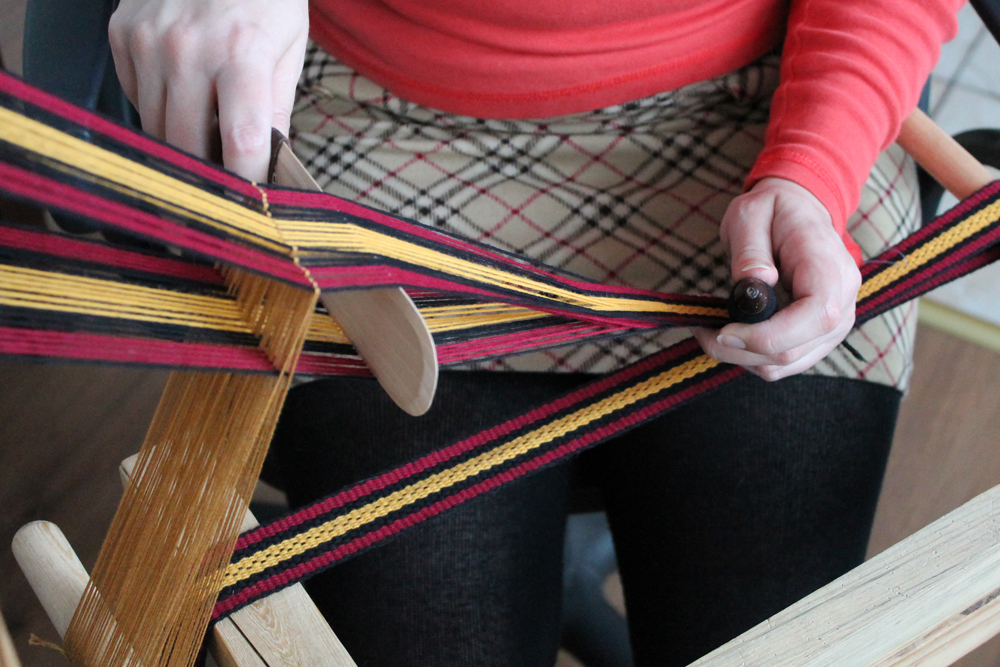
Then I press the selvedge down…

…and I move the shuttle from left to right.

The initial exercises were slow – about 0.5 meters per hour. It came out crooked and the shuttle fell out of my hand. Later I managed to speed up and the speed record is about 2.2 meters per hour. Ultimately, the weaving speed is lower because I prefer to tighten the weave very tightly, and not just hmm… decently.

The technique will be very useful for weaving simple selvedges, especially those made of thin yarn. The selvedges that are pulled out will remain unchanged, because when selecting threads it is better to sit symmetrically and in front of the work.

I noticed that my arms and hands hurt a little during such work. But my spine is completely relieved. And that's a positive change, because my back and neck tend to hurt for a few days after work, and the pain in my hands disappears within an hour or so.

In the post Express selvedges I published photos of the effects of using the quick technique.

Similar Posts

  • The most valuable weaving loom

    Today I present my most valuable weaving loom. Unfortunately, its historicity is a constant matter of dispute. Archaeological finds confirm the presence of such tools, but there is still no reliable study on their use in textiles. I suspect that there is a kind of scientific taboo in this area. Numerous, although fragmentarily preserved, relics are kept in secret warehouses and specially protected….

  • I'm still learning

    I'm just jumping from one YouTube video to another and I'm finding a ton of interesting stuff. Some phenomenally clever chick is showing the principles of weaving on a horizontal loom. I wish I had thought of those obvious solutions. Her method of setting up a half-harness is much simpler than the one I saw in Professor Turnau's book. A horizontal loom is a distant dream to me,…

  • Vertical looms – creating the warp.

    Today, during the Biskupin Festival, I finished a long-hanging fabric and my vertical looms are finally free. I also had an idea on how to simplify the creation of the warp. The edge selvedge worked well in the case of the apron, but it will not be needed in all cases. In addition, the warping and weaving of the edge selvedge with the addition of the actual fabric to the warp weft…

  • Vertical weight looms

    I planned to post some photos of my looms to illustrate the story of their creation, but uncle Google does such wonders with searches that I didn’t want to give him any more reasons to mix and match. People looking for information about looms and weaving might be horrified… I’ll just tell you that initially the looms consisted of a few joists, which were the subject of mockery by a certain Lord…

  • Opole Krajka

    I present another selvedge. The original comes from Ostrówek in Opole and is dated to the 4th quarter of the 11th century and the beginning of the 12th century. I used factory yarn, 100% wool. The number of threads in the warp is identical to the original, but my yarn is thicker, so the selvedge is also wider - instead of 2.5 cm it is 3.2 cm. Plain-grosgrain weave. Length 7.7…

Leave a Reply