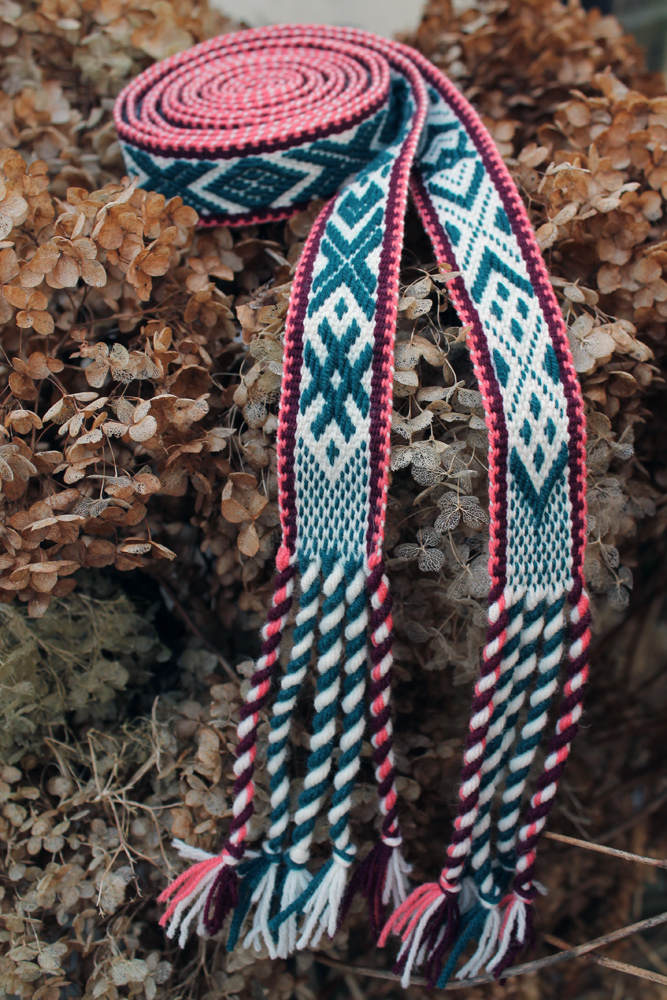
Norwegian salmon with eggplant in cream
If anyone is wondering what to make for dinner today, or how to prepare the salmon they just bought, and ended up here, I apologize for the confusion, because the post is about the recently woven selvedge 😉
 |
| Gardening tip: remove faded hydrangea inflorescences in spring – they may come in handy in winter 😉 |
I don't know much about colors, and especially their names, but (or maybe that's why) I'm fascinated by this subject. Many color names are associated with food. It so happened that I chose yarns in colors that I liked for weaving, and the manufacturer or seller gave them very food-related names.
I didn't find a place for this green from the pattern in the name of my dish, because I had a hard time fitting "sea green" or "petrol green". Especially since the terms used don't quite match this color. For me it's just a dark cool green, but as I said, I don't know, so I won't insist.
Regarding the term "Norwegian", I would like to clarify that this refers to the pattern. When browsing the page dedicated to Norwegian bunads http://www.norskflid.no/, I came across this photo:
 |
| If I understand correctly, this is a New Year's Eve outfit for the year 1800 with Porsgrunn region Telemark |
This pattern simply enchanted me and I really wanted to make it. The white background gives a great visual effect. Contrasting colors, but of similar brightness, won't look as nice. I like the way it's finished, but I'll test it another time. The patterns on the edges of the ribbon are also interesting. Such small decorations on the edges appear not only in Norwegian selvedges, but also in Lithuanian and Belarusian selvedges.
Unless I missed any pattern pieces hidden somewhere under other parts of the garment, the report consists of 6 elements separated by a hyphen. This is what the pattern report looks like on the left and right side:

Finally, I warn you honestly that you can find some hair from the Chef in this dish. The fact that the entire selvage is made of 100% hair (sheep) probably doesn't bother anyone 🙂
Beautiful lace pattern and beautiful colors
Yum, yum ^_^
it came out beautiful, I like it much better than in the original red :) now I have to learn how to weave those wide stripes – it's done on plates with holes – black magic…
These original reds are beautiful, but they can get boring and worn out. The plates are also black magic for me and a challenge to learn or overcome some resistance 🙂 Best regards